Sibling Loyalty
Big BrotherSibling Loyalty is the foundational attachment between Pandora Halfdanarson and her brother, Edison Appaloosa, and the bond that shapes how she understands her obligations to the rest of her family. For Pandora, Edison is not one relative among many: he is the person from whom she first learned loyalty, and the tie that makes her willing to act for him even when doing so places her at odds with Fletcher Feuerbach.
A Family Reduced to One Essential Bond
Pandora’s account of her family gives the sibling bond its particular force. Her mother, Magnolia Halfdanarson, died when Pandora was thirteen; both sets of grandparents had died, and Pandora had no children of her own. Her younger sister, Solstice, visited Iowa every other summer, but Pandora describes those visits as something Solstice herself insisted on maintaining. Solstice was the family member who bought presents, sent cards, and made regular visits, trying to impose a more coherent and appealing pattern on the family’s broken history. These relationships mattered, but Pandora identifies Edison as her sole blood relative whom she clearly and cleanly loved.
That distinction is not presented as a simple inventory of kin. Pandora says the loyalty that other people might distribute across a larger family was concentrated in her attachment to Edison. Their shared childhood gave them a past no one else could share in the same way. Even when Pandora felt ambivalent about that past, its shared ownership kept the bond distinct: Edison and Pandora had lived through it together.
Childhood Collusion and Shared History
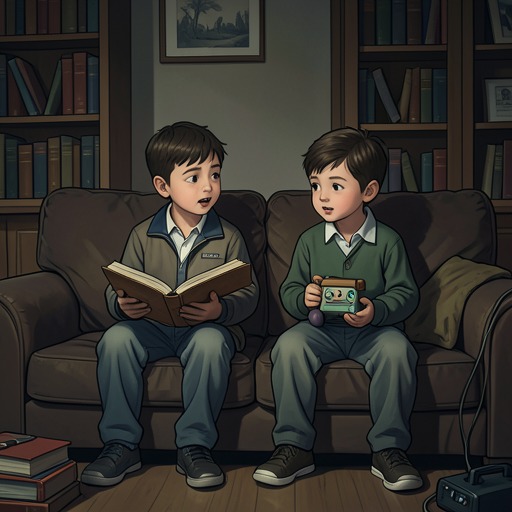
Pandora’s view of sibling loyalty is also informed by Joint Custody, the television show associated with her father, Travis Appaloosa. She admires the way the show represents children as belonging to a separate world from their parents. In its family, Mimi and Emory Fields are often made to look foolish, while the siblings’ intense collusion is treated as the children’s source of salvation. The parents may feel ashamed of drawing their children into opposing loyalties, but they fail to recognize that the children’s strongest allegiance is to one another.
Pandora connects that portrayal to her own relationship with Edison. She acknowledges that the two siblings sometimes turned each other in to their parents, but characterizes those incidents as isolated maneuvers within a more consequential private relationship. Their parents could be used as leverage in sibling disputes; they were not the center of the children’s shared world. The underlying intimacy, rather than an idealized absence of conflict, is what made their loyalty durable.
The same insight informs Pandora’s conduct as a stepmother to Tanner and Cody. She tries to remember that children know their parents’ secrets even when adults do not know the children’s. Her understanding of sibling intimacy therefore reaches beyond her own childhood: it shapes her awareness that children maintain relationships and knowledge outside the adults’ control.
Loyalty Against Marital Disagreement
When Fletcher objects to Pandora bringing Edison into their home, Pandora considers whether her ownership of the house gives her the right to put her brother in the guest room without her husband’s permission. She rejects relying on that financial authority as undemocratic. Her decision is not framed as a straightforward contest over property, but as a conflict between household negotiation and a prior, deeper allegiance.
Pandora explains that she is not generally held captive by family ties. Her relationship with her father remains difficult, and she expects to understand its depth only after his death; meanwhile, she feels free to find him unbearable. Her connection with Solstice is also more limited and maintained largely at Solstice’s initiative. Against this background, Edison’s place is exceptional. Pandora says she did not hesitate when Slack Muncie called about him, and recognizes that Fletcher was right to understand the call as a trump. Edison is her brother, a fact that, in her account, could have ended the argument.
The episode clarifies the cost as well as the strength of sibling loyalty. Pandora initially believes that devotion to Edison does not diminish her devotion as a wife. Fletcher, an only child, resents the ferocity of the siblings’ mutual attachment. Pandora thinks he should instead envy the intimacy on its own terms: an only child, she argues, is grouped with the people who supervise them, without a sibling to form an independent alliance. Her loyalty is not depicted as proof that marriage is unimportant; it is a relationship whose history and intensity do not fit neatly inside marital expectations.
Meaning and Wider Reach
For Pandora, loyalty begins with Edison and extends outward: she says that her capacity for fierce attachment to Fletcher and the children flowed from what she first learned as Edison’s sister. The sibling bond is thus both particular and generative. It is not interchangeable with later relationships, but it helps explain how Pandora is capable of clinging to other people with comparable force.
The novel places this personal conviction beside Joint Custody’s representation of children’s private alliances. Both make sibling intimacy a counterweight to adult authority and family instability, while Pandora’s own choices show that the attachment does not end with childhood. It persists into marriage, becomes visible in a disagreement about taking Edison into the home, and exposes how family loyalties can resist being distributed according to conventional household roles.